Cultivation
Seven Thousand Strains, One Feed Chart: Cannabis Is Farming Like Iowa
I'm an Iowan. Born and raised. I grew up on top of some of the most fertile ground on the planet, and in 2011 I left it to launch into cannabis. Fifteen years and more than ten state markets later, I've worked operations, compliance and brands. My last vertical was Good Weed in Colorado Springs, which I co-founded and ran from 2017 to 2019.
My concern is simple. Cannabis is repeating monoculture agriculture's mistakes, and it's refusing to take the stronger course while it still can.
Passing isn't the same as clean
I've seen entire production runs bleached out and re-ran. Spider mites on PM that eventually gets sold as BHO. Botrytis buds that pass TYM. I'm not naming names. It's a system that rewards whatever gets you a passing CoA.
A passing CoA tells you what a lab found in the sample it was handed, using the tests the state required. That leaves gaps.
Start with mold. Powdery mildew is an obligate biotroph. It can't be cultured1. TYM is a plate count, and powdery mildew doesn't grow on TYM plates. A cannabis testing lab confirms PM doesn't register in standard yeast-and-mold tests2. PCR can detect it, but it isn't typically required. Botrytis looks like the same story. A qPCR vendor ran its own plating test and got no Botrytis growth after eight days on standard media3. Per the vendor, labs incubate those plates 72 hours, tops. They sell the alternative test, so weigh that, but it matches what I've seen in the room.
Then there's the map. California has no TYM limit4. Colorado requires one5. Both screen for specific Aspergillus species, so nobody's totally blind, but they're not looking at the same things. Oregon, at the time of its 2019 state audit, didn't require microbiological testing. It used water activity as a stand-in for mold6. As of 2022, 36 states plus DC regulated 679 contaminants7, and action levels varied by up to four orders of magnitude. That's up to a 10,000-fold spread, depending on which state line you're behind. No federal standard.
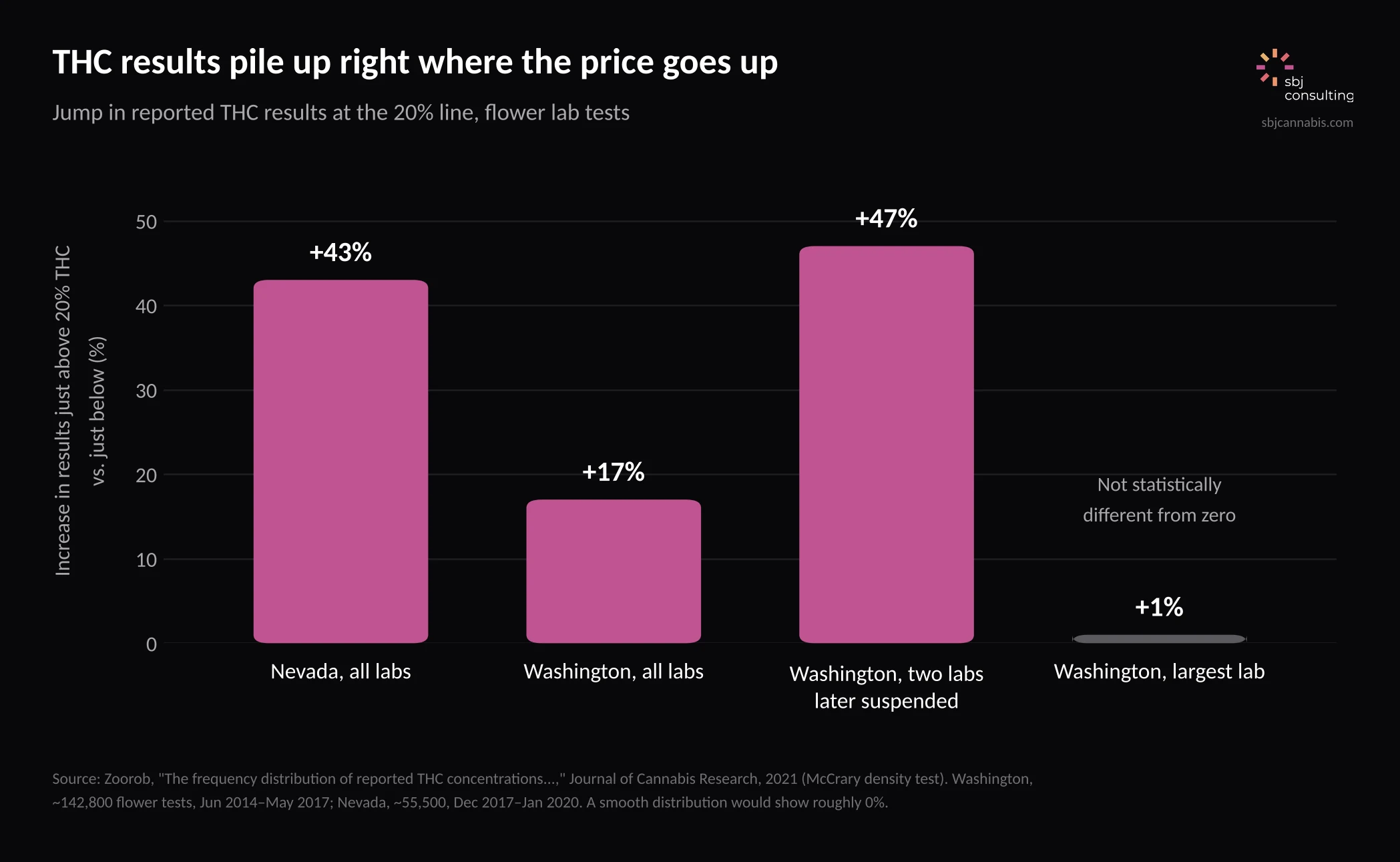
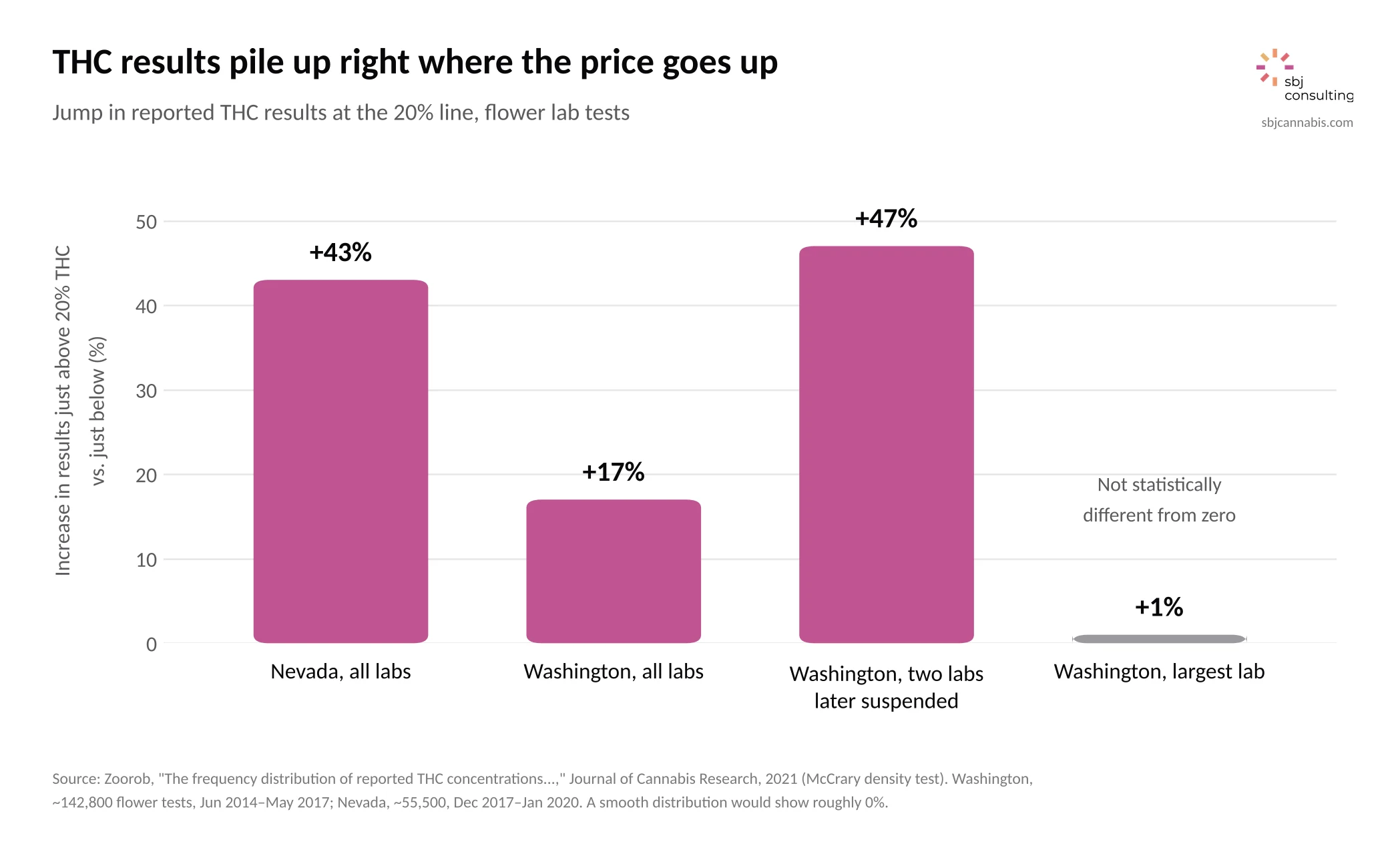
The potency number has its own gaps. Researchers bought Colorado retail flower labeled 20.27% to 24.10% THC. It averaged 14.98%8. The authors pointed to non-standardized sampling, with "limited to no enforcement" of sampling guidelines. In Nevada and Washington, reported THC results bunch up just above 20%9, right where the market pays more. The jump was about 43% in Nevada and 17% in Washington. At two Washington labs that were later suspended, it was about 47%. At the state's largest lab, about 1%. Lab shopping is real. Oregon's own auditors wrote that "industry pressures may affect lab practices and the accuracy of results."6
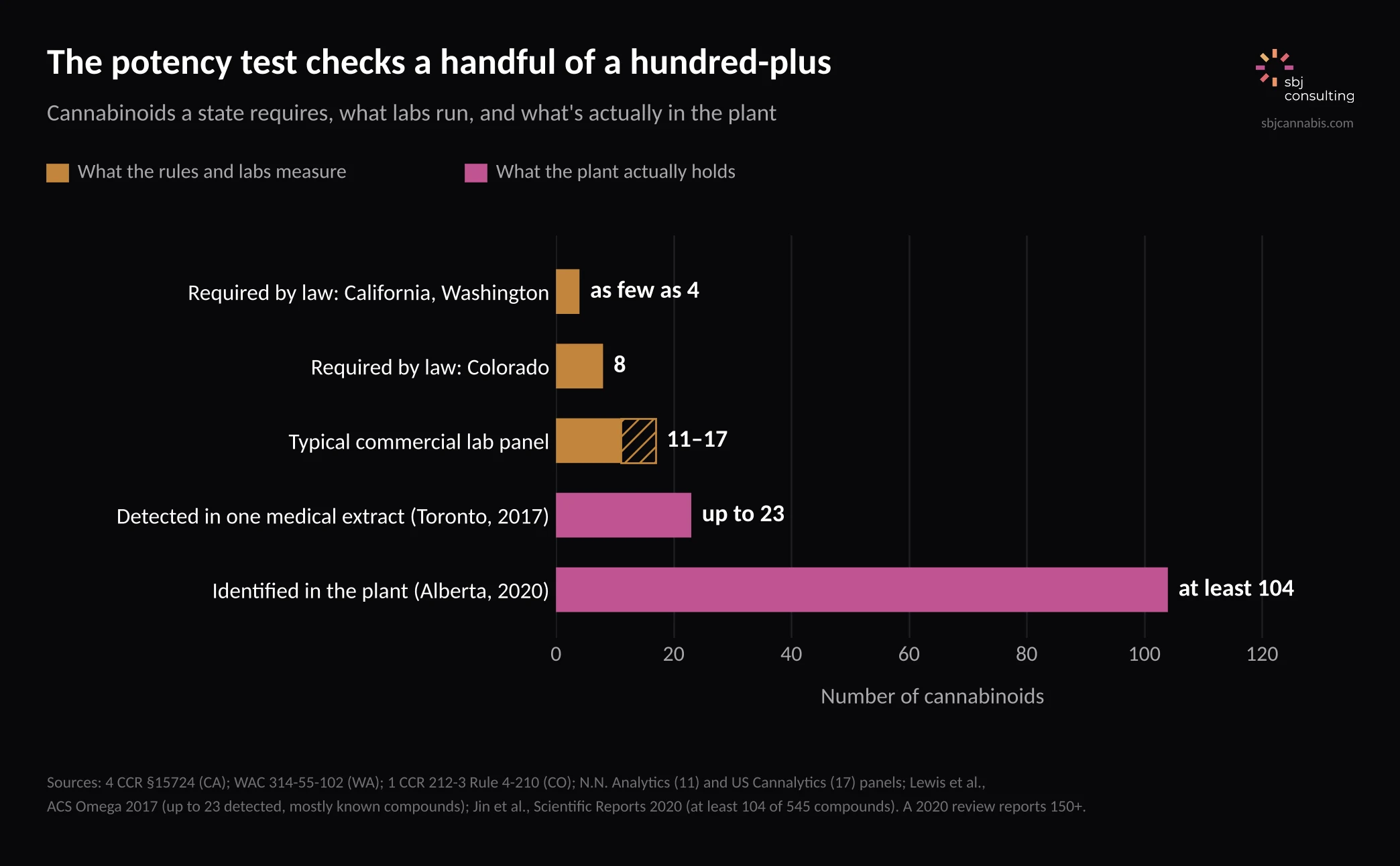
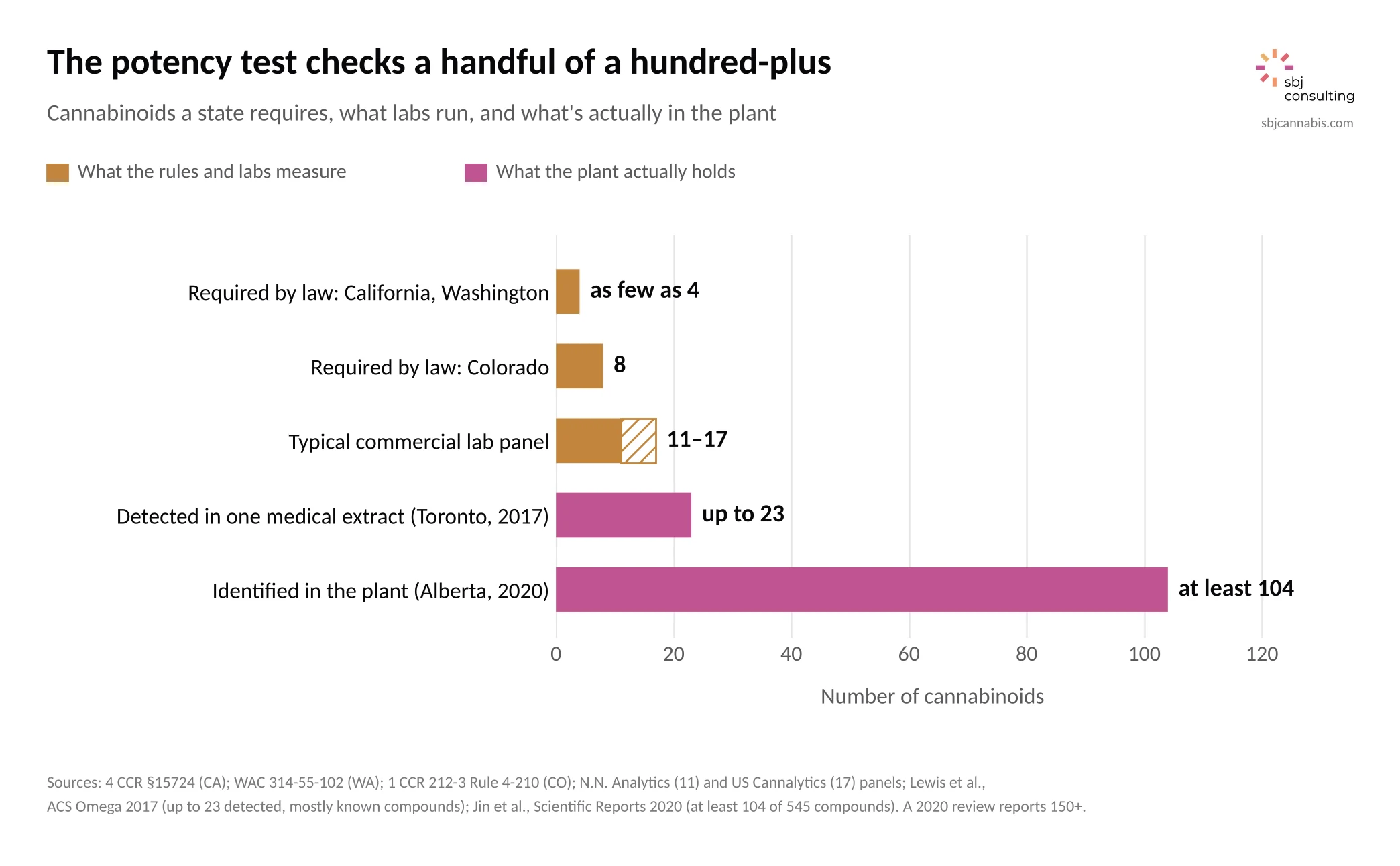
And the potency panel itself is short. State rules require as few as four cannabinoids, in California10 and Washington11. Colorado requires eight12. Commercial lab panels commonly run 1113 to 1714. Regulators are checking safety and the label, not describing the plant.
In 2019 I gave a talk called "Medicine or Poison." My advice then was simple: check the CoA. I'd update that now. Check the CoA, and ask how it got there.
Smoke changes the chemistry
Poisons are giving cannabis a bad rap. And most people still light this plant on fire, so combustion chemistry is part of the product.
One study put four pesticides on cannabis and smoked it through three kinds of pipes. Up to 69.5% of certain residues carried straight into the smoke15. That's the max, not the average, and it varied by device and chemical. A 2020 review says flatly that no research exists on the toxicity of pyrolyzed pesticides in humans from smoking cannabis16. We're running that experiment on customers.
Meanwhile, no pesticide product is federally registered for use on cannabis17. Growers work off state lists, minimum-risk products and IPM.
Myclobutanil is the poster child. A manufacturer's safety data sheet lists hydrogen cyanide18 among its combustion breakdown products. I want to be straight about dose. Health Canada looked at trace residues in recalled product and judged the added cyanide risk low19, far below what's already in cannabis smoke. Dose matters, so look at doses. When Maine audited 120 medical-program samples, 42% would have failed adult-use standards20. Myclobutanil was the most common pesticide, and one sample hit 58,600 ppb, 293 times the threshold. That ain't trace. In Oregon, myclobutanil racked up 225 failed tests out of 333 detections6.
Quality in, quality out. Processing doesn't clean a plant. It concentrates it. A Cannabis Safety Institute white paper on 2014 Oregon lab data found mean levels of two pesticides roughly 10x higher in concentrates than in flower21, while cannabinoids only concentrate about 2 to 5x. Old data, one industry group, two compounds. Now think about that mite-and-PM flower shipped off to become BHO.
Organic inputs, conventional thinking
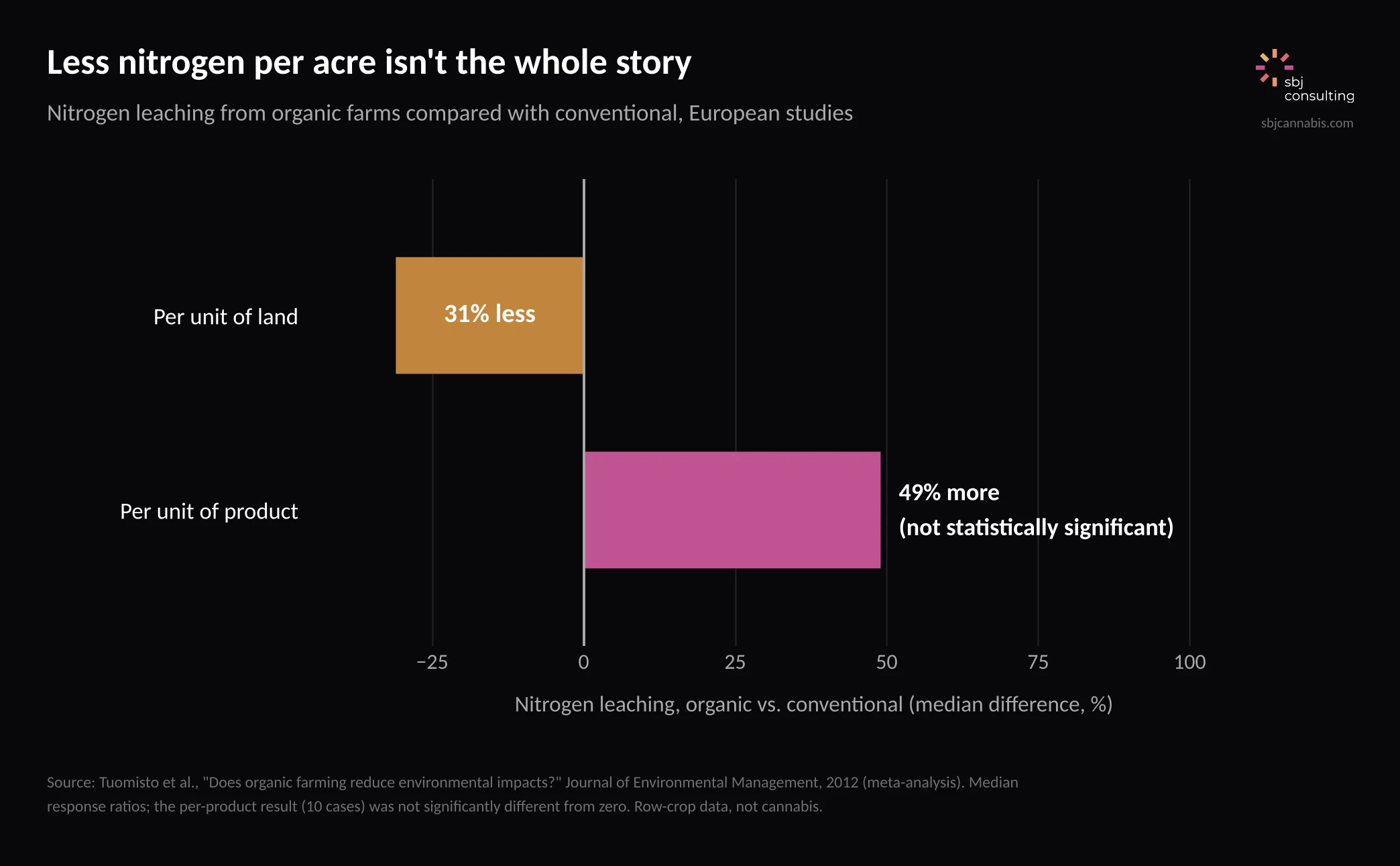
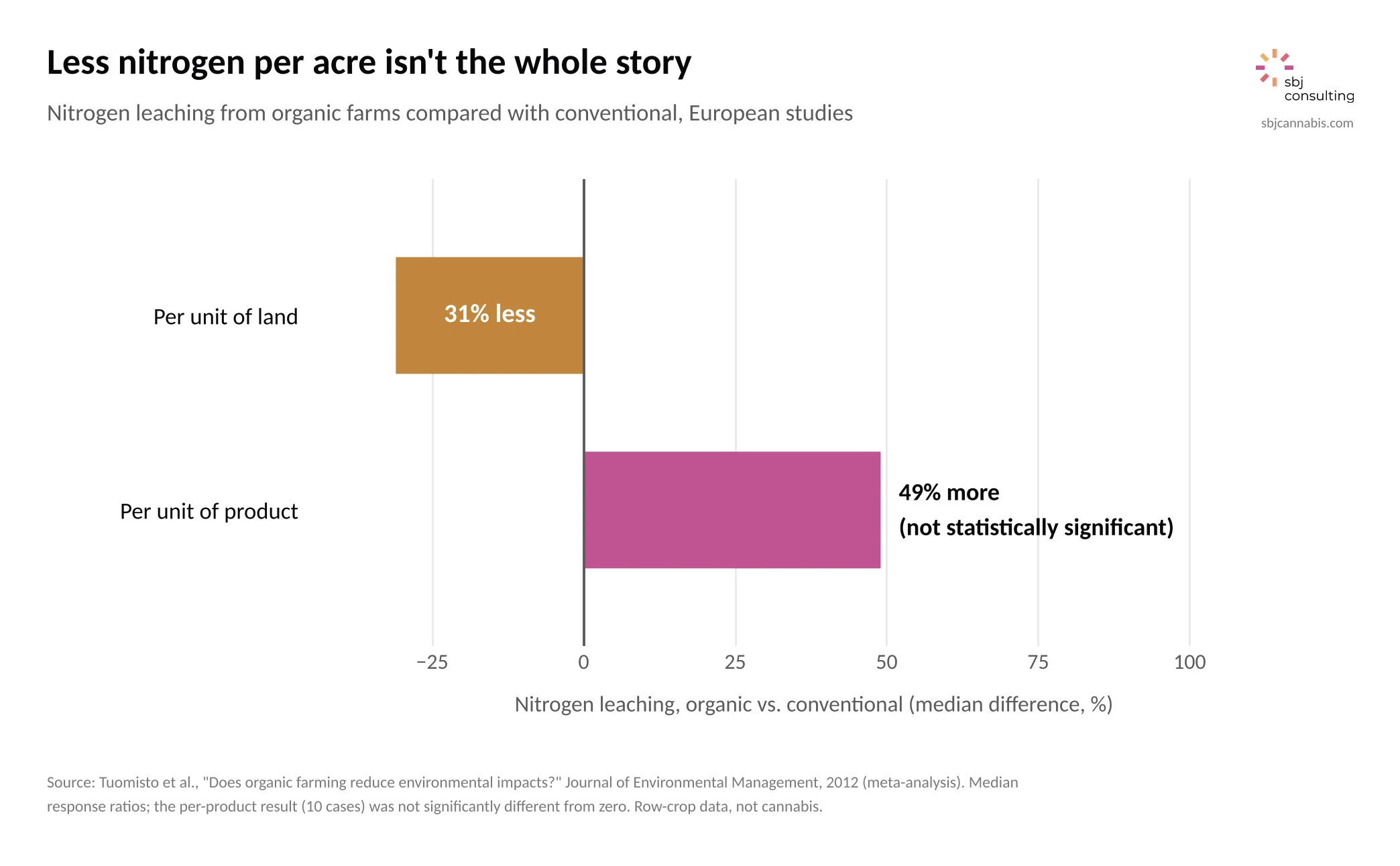
A lot of "organic" growers are running organic inputs with conventional thinking. Same feed schedule, same heavy hand. Swapping the bottle for a bag of meal isn't a revolution. A meta-analysis of European farm research found organic systems leached about 31% less nitrogen per unit of land but about 49% more per unit of product22. That per-product gap wasn't statistically significant, so treat it as a warning, not a verdict. The authors said organic's main challenge is improving nutrient management. Fair.
A California water board sampled wastewater at seven indoor facilities and found nitrate-N as high as 200 mg/L23. The drinking-water limit is 10.
Now the honest part. I couldn't find one study comparing nitrate leaching from living-soil cannabis against a bottled nutrient program. Not one. What we have is row-crop science, and it's loud. A global meta-analysis found non-legume cover crops cut nitrate leaching by 56%24 on average. At Iowa State's Marsden Farm, corn in diverse three- and four-year rotations had 57% lower drainage-water nitrate25 than corn-soy, using 86 to 91% less mineral nitrogen. Yields and profits held up26.
The farm science points our way, and cannabis hasn't measured it yet. So let's measure it. Living soil or bottles, catch your leachate and test it. Labs, universities, regulators: put it on the research list, and publish whatever it says.
Cycling versus providing
The way I see it, in a living soil system, biology is cycling. In hydro, and in most bottled programs, you're providing. That works, but only if you know everything the plant needs.
Living soil isn't a free pass. Amendments leach too if you overdo them. The real answer is feeding the soil at the rate the biology can cycle it and letting the soil food web hold the rest.
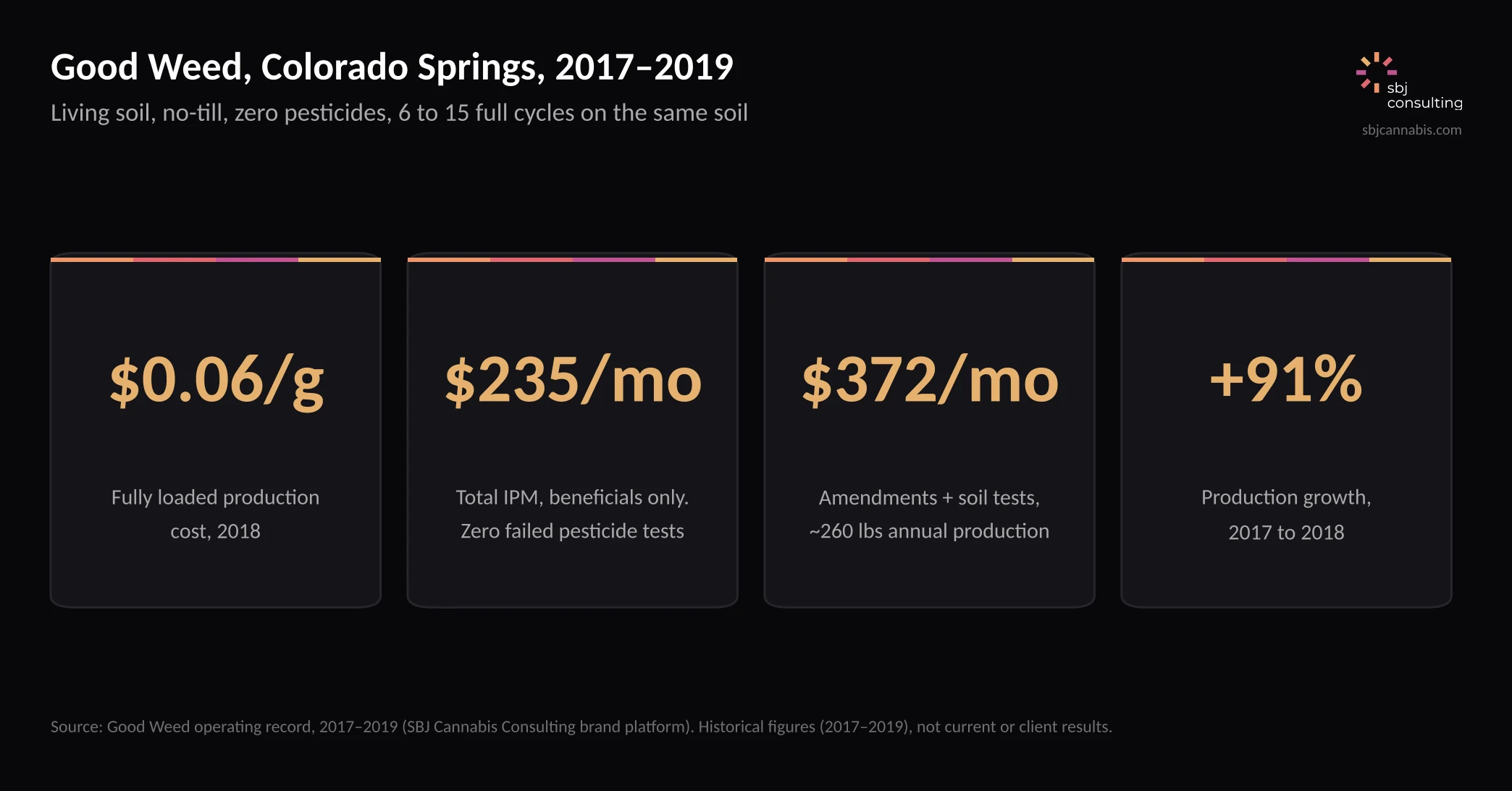
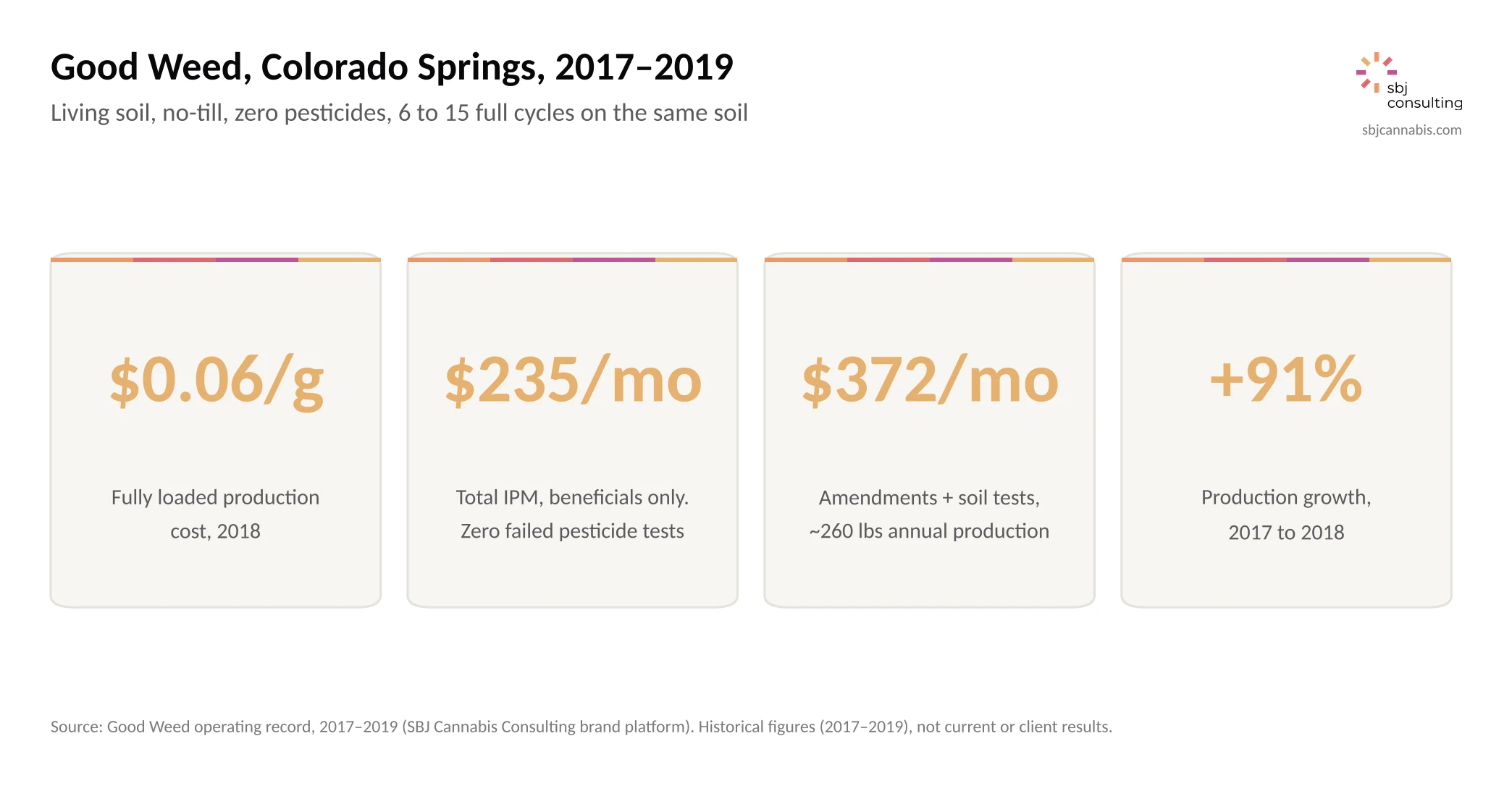
I learned that on my own P&L. From 2017 to 2019, Good Weed ran vertically integrated, no-till, small-batch living soil with zero pesticides. The same soil carried 6 to 15 full cycles, no till and no flush. IPM was beneficials only, $235 a month, with zero failed pesticide tests. Amendments and soil tests ran $372 a month for about 260 pounds of annual production. Fully loaded production cost came in at six cents a gram in 2018, and production grew 91% from 2017 to 2018. Those were good years. What I remember most is our 300 loyal customers, the regulars who kept coming back. They never saw a cost sheet. They just knew the jar.
The soil food web isn't a slogan. It's a body of research, and if living soil has a godmother, it's Dr. Elaine Ingham, who died in February 2026. A soil microbiologist trained at Colorado State, she spent four decades studying the life in soil. Her 1985 paper with colleagues in Ecological Monographs laid out how bacteria, fungi and the nematodes that graze on them drive nutrient cycling and plant growth27. She co-authored the USDA's Soil Biology Primer and founded the Soil Food Web School, which has enrolled more than 8,000 students in 140-plus countries28. That's cycling, measured.
Science learns more every day. Some processes in that soil nobody has studied yet are probably contributing results we haven't measured or even observed. In a biological system, a biological mechanism is best suited. Until we know everything, which we never will. Or until we change the definition of success, and that's where bias creeps in. If success means yield and THC, you optimize away everything you didn't measure.
And there's a lot we don't measure. University of Alberta researchers counted at least 104 cannabinoids among 545 compounds29, and a 2020 review puts the number at more than 15030. A Toronto team found up to 23 phytocannabinoids in a single commercial medical extract31. We're still finding them: researchers in Italy identified THCP and CBDP32 in 2019. Set that against a state panel of four to eight. That's why SBJ measures potency by total cannabinoids, not THC.
Can you run hydro effectively and ethically? Sure. It just takes an enormous amount of knowledge. Living soil is best. For now.
Seven thousand strains, one diet
Researchers counted 7,037 strains listed on Leafly as of late 202333. Those are names, and lab data show names don't consistently line up with the chemistry34. The grow room is diverse too. In a 2022 Cannabis Business Times survey, 60% of growers had 1 to 10 cultivars in flower at once35.
On October 20, 2026, I pulled up the online flower menus for six big stores in LA and Denver. Each one listed somewhere between 18 and 75 named strains, and that's a floor, since plenty of jars don't name a cultivar at all. A couple of the LA shops were selling flower labeled nothing more than "Indica Blend," "Sativa Blend" or "Hybrid Blend." That's my own quick look at six menus, not a study.
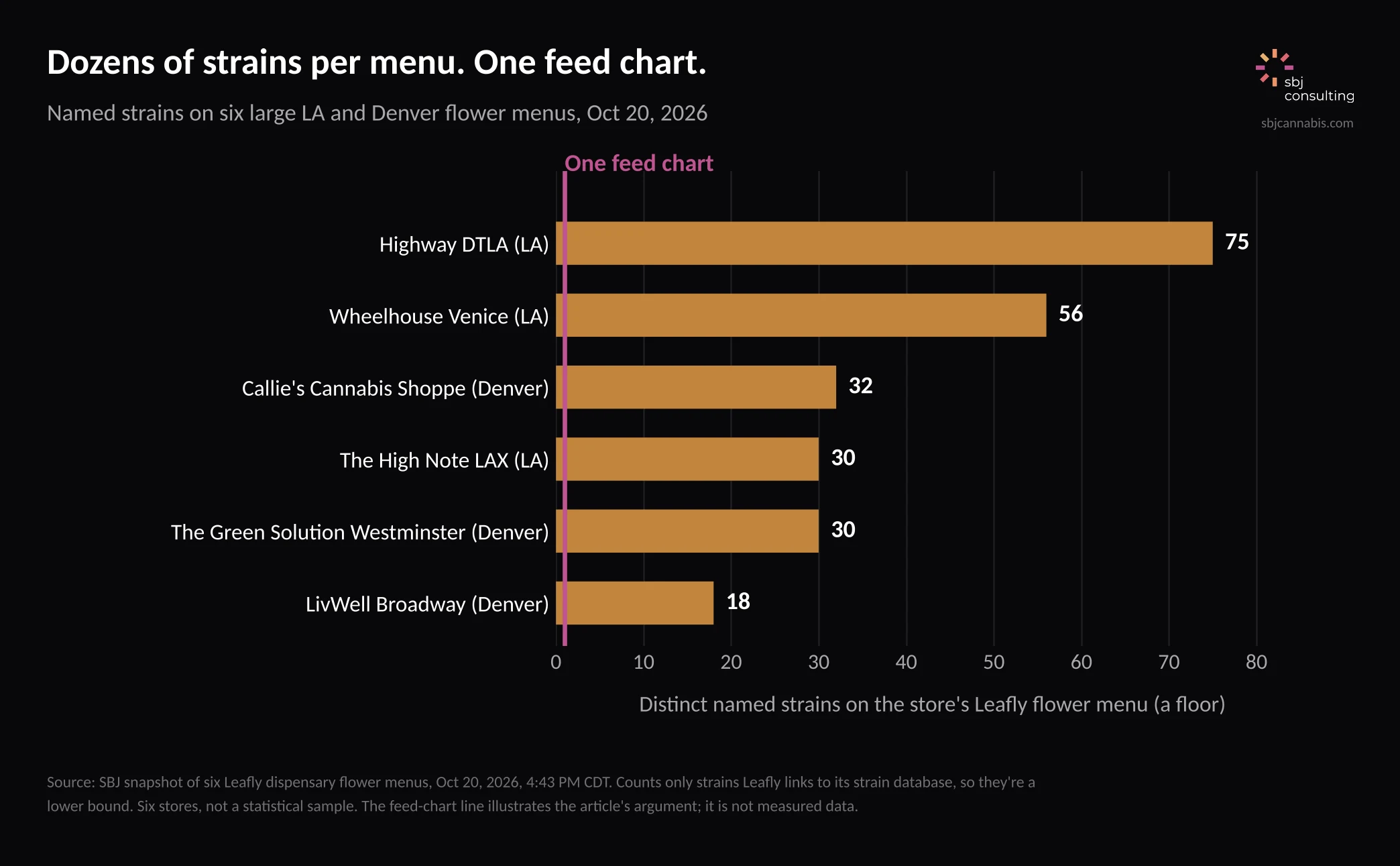
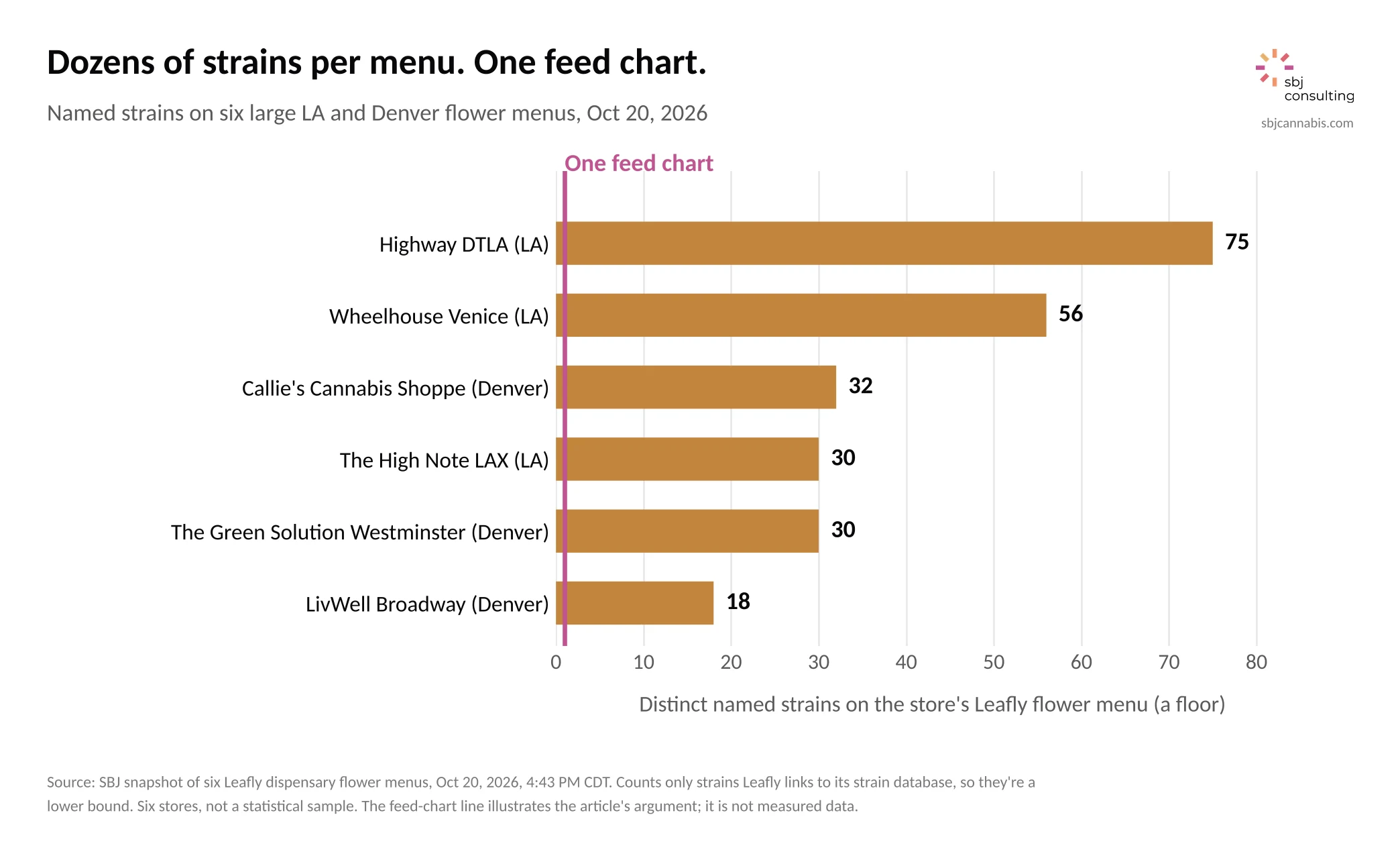
Every one of those cultivars has its own diet. Different appetite, different stretch. And most rooms feed them all off one feed chart, then hit them all with the same spray when something goes sideways. That's monoculture. We just dressed it up with fun names.
Extracts get the same treatment. In my experience, plenty of material gets blended and renamed downstream. That's my observation, not a stat.
I care about flower. It's still the biggest category, about 39% of US sales36, even though vapes passed it in California in July 202537. THC chasing gave us inflated labels and bleached runs. The plant is smarter than our feed chart, and living soil systems have the most room for error, for wonder and for compounding success.
SBJ means boof proof for a reason. Principles over profit. Grow it like it's alive, because it is.
Sources
- British Society for Plant Pathology, "BSPP Plant Doctor Quiz #31," 2023. https://www.bspp.org.uk/bspp-plant-doctor-quiz-31-october-2023/
- Trichome Analytical, "Powdery Mildew on Cannabis: Detection Myths & Realities" (testing-lab source, undated). https://trichomeanalytical.com/powdery-mildew-on-cannabis-detection-myths-realities/
- Medicinal Genomics, "PathoSEEK Total Yeast and Mold Count Inclusivity" (qPCR vendor's own test). https://help.medicinalgenomics.com/en/tym-inclusivity
- California Code of Regulations, 4 CCR § 15720 (via Cornell LII). https://www.law.cornell.edu/regulations/california/4-CCR-15720
- Colorado Code of Regulations, 1 CCR 212-3, Rule 4-215 (via Cornell LII). https://www.law.cornell.edu/regulations/colorado/1-CCR-212-3-4-215
- Oregon Secretary of State Audits Division, Report 2019-04, Jan 2019 (copy hosted by the Kansas Legislature). https://kslegislature.gov/li_2022/b2021_22/committees/ctte_spc_2022_medical_marijuana_1/documents/testimony/20221019_17.pdf
- Jameson et al., "Comparison of State-Level Regulations for Cannabis Contaminants and Implications for Public Health," Environmental Health Perspectives, 2022. https://pmc.ncbi.nlm.nih.gov/articles/PMC9472674/
- Schwabe et al., PLOS ONE, 2023 (Colorado retail flower THC vs. label). https://pmc.ncbi.nlm.nih.gov/articles/PMC10096267/
- Zoorob, "The frequency distribution of reported THC concentrations of legal cannabis flower products increases discontinuously around the 20% THC threshold in Nevada and Washington state," Journal of Cannabis Research, 2021. https://link.springer.com/article/10.1186/s42238-021-00064-2
- California Code of Regulations, 4 CCR § 15724 (cannabinoid testing, via Cornell LII). https://www.law.cornell.edu/regulations/california/4-CCR-15724
- Washington Administrative Code, WAC 314-55-102. https://app.leg.wa.gov/wac/default.aspx?cite=314-55-102
- Colorado Code of Regulations, 1 CCR 212-3, Rule 4-210 (via Cornell LII). https://www.law.cornell.edu/regulations/colorado/1-CCR-212-3-4-210
- N.N. Analytics, "Cannabinoid Potency" (11 Cannabinoid Panel by HPLC/DAD). https://www.nnanalytics.com/product/cannabinoid-potency/
- US Cannalytics, "Potency" (up to 17 cannabinoids). https://uscannalytics.com/testing-services/potency/
- Sullivan, Elzinga & Raber, "Determination of Pesticide Residues in Cannabis Smoke," Journal of Toxicology, 2013. https://pmc.ncbi.nlm.nih.gov/articles/PMC3666265/
- Taylor & Birkett, "Pesticides in cannabis: A review of analytical and toxicological considerations," Drug Testing and Analysis, 2020. https://analyticalsciencejournals.onlinelibrary.wiley.com/doi/10.1002/dta.2747
- California Department of Pesticide Regulation, "Cannabis Cultivation." https://www.cdpr.ca.gov/cannabis-cultivation/
- Davey Tree, "Myclobutanil 20 EW Safety Data Sheet." https://www.davey.com/media/vnobb0tv/myclobutanil-20ew_sds.pdf
- Health Canada, "Clarification from Health Canada on myclobutanil and cannabis," 2017. https://www.canada.ca/en/health-canada/news/2017/03/clarification_fromhealthcanadaonmyclobutanilandcannabis.html
- Maine Office of Cannabis Policy, contaminant audit news release, 2023. https://www.maine.gov/dafs/ocp/news-events/news/office-cannabis-policy-report-identifies-harmful-contaminants-42-samples-collected
- Cannabis Safety Institute, "Pesticide Use on Cannabis" (white paper), June 2015. https://cdn.technologynetworks.com/tn/Resources/pdf/pesticide-use-on-cannabis.pdf
- Tuomisto et al., "Does organic farming reduce environmental impacts? A meta-analysis of European research," Journal of Environmental Management, 2012. https://doi.org/10.1016/j.jenvman.2012.08.018
- California Water Boards (Lahontan), "Industrial Cannabis Cultivation Wastewater Characterization Study 2023." https://www.waterboards.ca.gov/lahontan/water_issues/programs/cannabis/doc/wastewater-characterization-summary.pdf
- Thapa, Mirsky & Tully, "Cover Crops Reduce Nitrate Leaching in Agroecosystems: A Global Meta-Analysis," Journal of Environmental Quality, 2018. https://doi.org/10.2134/jeq2018.03.0107
- Iowa Nutrient Research Center, "Marsden Long-Term Rotation Study." https://inrc.cals.iastate.edu/project-location/marsden-long-term-rotation-study
- Davis et al., "Increasing Cropping System Diversity Balances Productivity, Profitability and Environmental Health," PLOS ONE, 2012. https://journals.plos.org/plosone/article?id=10.1371/journal.pone.0047149
- Ingham, Trofymow, Ingham & Coleman, "Interactions of Bacteria, Fungi, and their Nematode Grazers: Effects on Nutrient Cycling and Plant Growth," Ecological Monographs 55:119–140, 1985. https://doi.org/10.2307/1942528
- Soil Food Web Foundation, "About Us" (history of Dr. Elaine Ingham's work), accessed Oct 21, 2026. https://www.soilfoodweb.com/about-us/
- Jin et al. (University of Alberta), Scientific Reports, 2020 (at least 104 cannabinoids among 545 compounds). https://www.nature.com/articles/s41598-020-60172-6
- Shahbazi et al., "Cannabinoids and Cannabinoid Receptors: The Story so Far," 2020 review (more than 150 cannabinoids). https://pmc.ncbi.nlm.nih.gov/articles/PMC7339067/
- Lewis et al. (Toronto), "Chemical Profiling of Medical Cannabis Extracts," ACS Omega, 2017. https://pmc.ncbi.nlm.nih.gov/articles/PMC6044620/
- Citti et al., Scientific Reports, Dec 2019 (identification of THCP and CBDP). https://www.nature.com/articles/s41598-019-56785-1
- Yoon et al., "Surveillance of Cannabis Strains Using Online Data: Observational Study," JMIR Formative Research, 2026. https://pmc.ncbi.nlm.nih.gov/articles/PMC13229463/
- Smith et al., "The phytochemical diversity of commercial Cannabis in the United States," PLOS ONE, 2022. https://pmc.ncbi.nlm.nih.gov/articles/PMC9119530/
- Cannabis Business Times, "Cultivation Challenges and Goals," 2022. https://www.cannabisbusinesstimes.com/business-issues-benchmarks/cannabis-consumer-trends/article/15692913/cultivation-challenges-and-goals
- Headset, "Cannabis Industry Statistics 2026." https://www.headset.io/data/cannabis-industry-statistics
- Cannabis Business Times, "Vape Sales Dethrone Cannabis Flower for 1st Time in California," Jan 30, 2026. https://www.cannabisbusinesstimes.com/us-states/california/news/15815985/vape-sales-dethrone-cannabis-flower-for-1st-time-in-california